

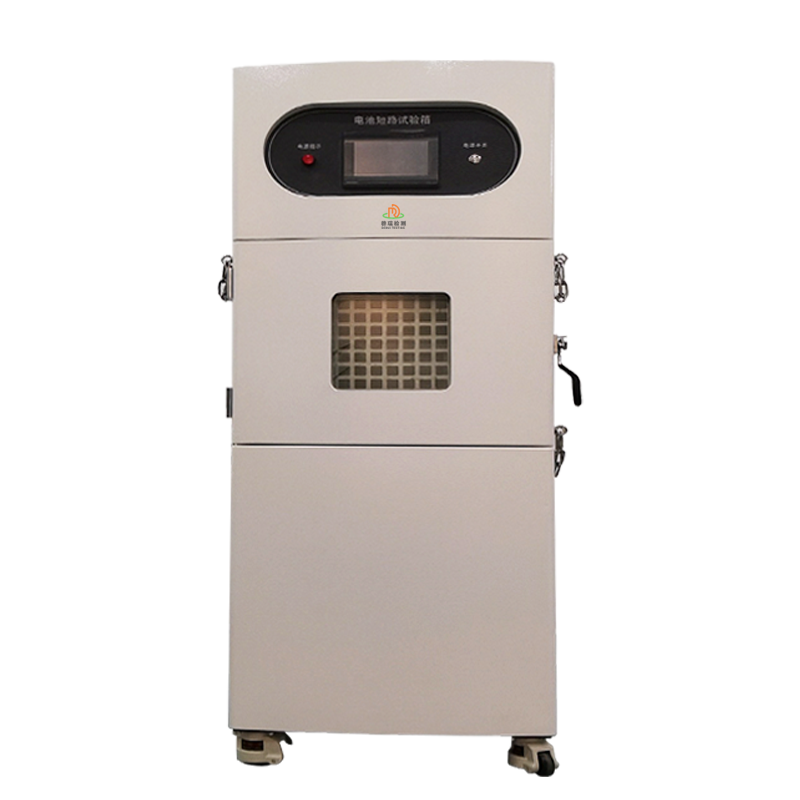
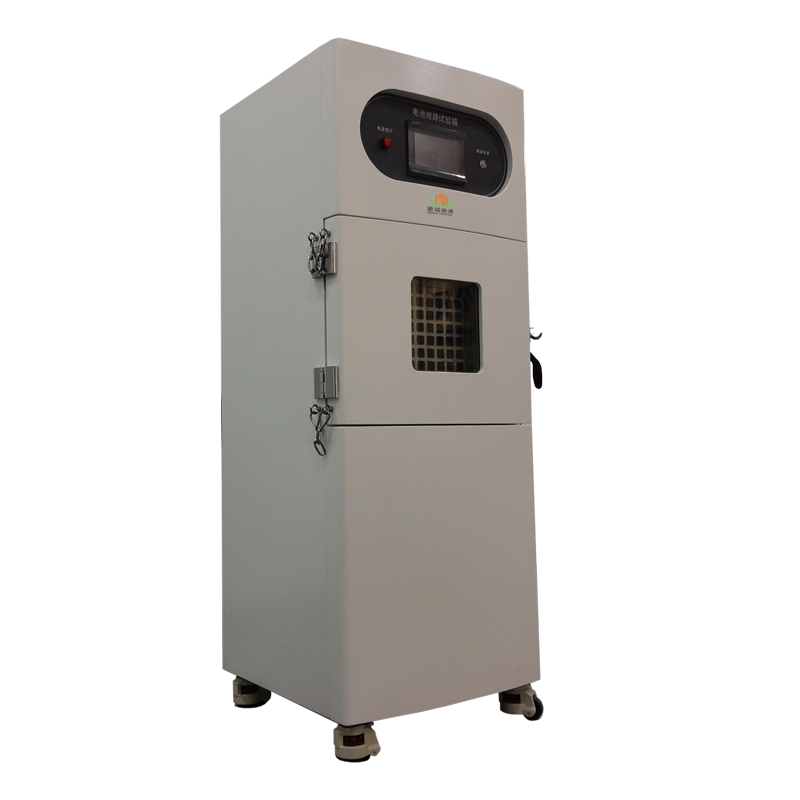
Battery forced internal short circuit testing machine
158005.0 INR/Unit
Product Details:
- Operating Voltage 220V AC
- Number of Specimens 1 sample per test
- Port Size 8 mm quick-connect
- Gas Pressure 0.5~0.8 MPa (clean and dry compressed air)
- Display Type Touch screen digital display
- Temperature Room temperature to 60C (adjustable)
- Features Automatic data recording, precision force sensor, customizable test parameters
- Click to view more
X
Battery forced internal short circuit testing machine Price And Quantity
- 158005.0 INR/Unit
- 1 Unit
- High precision load cell
- Test report export (CSV/Excel format)
- <65 dB @ 1 meter
- Meet GB, IEC, UN38.3, and other international standards
- Clean, dry compressed air (user provided)
- Windows OS based control software
- 750 x 500 x 1400 mm
- Supported
- Explosion-proof observation window and sealed test chamber
- English/Chinese (selectable)
Battery forced internal short circuit testing machine Product Specifications
- 0.1 N
- Forced internal short circuit test on lithium-ion battery cells
- Floor standing
- 0-90% RH (non-condensing)
- <1 ms
- Battery Safety Testing Equipment
- RS485, USB
- AC 220V, 50/60 Hz
- 1500 mm (machine overall)
- 0~3000 N
- Max 250 250 mm
- Fully automatic
- 0~300 mm (adjustable)
- 50/60 Hz
- Battery cell internal short circuit testing
- 1% F.S.
- 0~300 mm
- Up to 300 mm
- N/A (not applicable for device itself)
- 220V AC
- 1 sample per test
- PLC touch screen control
- 0.1~600 mm/min (adjustable)
- 8 mm quick-connect
- 0.5~0.8 MPa (clean and dry compressed air)
- Touch screen digital display
- Approx. 300 kg
- 3000 N max force
- Automatic data recording, precision force sensor, customizable test parameters
- Room temperature to 60C (adjustable)
- High precision load cell
- Test report export (CSV/Excel format)
- <65 dB @ 1 meter
- Meet GB, IEC, UN38.3, and other international standards
- Clean, dry compressed air (user provided)
- Windows OS based control software
- 750 x 500 x 1400 mm
- Supported
- Explosion-proof observation window and sealed test chamber
- English/Chinese (selectable)
Battery forced internal short circuit testing machine Trade Information
- Cash in Advance (CID)
- 101 Unit Per Month
- 5 Days
- All India
Product Description
| Model | DR-D201 |
| Inner box size | 500x500x500mm (width x depth x height); |
| Equipment dimensions | 700x800x1530mm (width x depth x height); |
| Internal material | SUS201 stainless steel plate, thickness 1.2mm, with Teflon affixed; |
| External material | 1.5mm thick cold-rolled steel plate with paint treatment; |
| Observation window | The size is 250x250mm two-layer tempered glass, the transparent window is equipped with stainless steel mesh; |
| Smoke outlet | 100mm in diameter, located at the back of the box; |
| Pressure relief port | The size of the opening is 200x200mm, located on the back side of the box. When the sample explodes, the pressure relief port will pop open to relieve the pressure; |
| Box door | The single door opens to the left, the box door is equipped with a safety limit switch, and the side is equipped with an explosion-proof chain. The device can be operated only when the box door is closed to ensure the safety of personnel; |
| Test hole | There are 2 test holes with a diameter of 50mm on the left side of the device, which are convenient for putting in the collection lines of temperature, voltage, current, etc.; |
| Lighting device | It is convenient to observe the state of the tested sample; |
| Temperature collection range | RT-1000; |
| Temperature acquisition channel | 1 channel; |
| Temperature display accuracy | 0.5; |
| Voltage acquisition range | 0-100V; |
| Voltage acquisition channel | 1 channel; |
| Voltage display accuracy | 0.5%; |
| Maximum short-circuit current | 1000A; |
| Current acquisition channel | 1 channel; |
| Current display accuracy | 0.5%; |
| The internal resistance of the device loop | 8020m; |
| Equipment movement | There are four universal casters at the bottom of the equipment, which can be moved freely; |
| Control method | PLC touch screen control; |
| Equipment weight | 85Kg |
| Power supply | AC220V;50Hz/60Hz |
Battery Forced Internal Short Circuit Tester
1. Equipment Overview
The Battery Forced Internal Short Circuit Tester is a precision test equipment specially designed for evaluating the safety performance and thermal runaway behavior of lithium-ion batteries and other types of batteries in the event of an internal short circuit. Internal short-circuit is a serious failure that may occur during the use of batteries, which may lead to a large amount of heat generated inside the battery, and then lead to thermal runaway, or even fire or explosion. Through the mandatory internal short circuit test, it can simulate the internal short circuit situation in actual use and evaluate the safety and stability of the battery under extreme conditions.
2. Main Functions
Internal short-circuit simulation: Create short-circuits inside the battery by mechanical or electrochemical means to simulate the short-circuit situation in actual use.
Thermal runaway assessment: Monitor the temperature change of the battery during the internal short-circuit process, and assess its thermal runaway risk and thermal runaway behavior.
Safety testing: Evaluate the safety performance of the battery under different temperature and pressure conditions to ensure its reliability in actual use.
Data Acquisition and Analysis: Real-time acquisition of battery temperature, voltage, current and other data, and generation of detailed test reports.
Safety Protection: Equipped with multiple safety protection devices, such as explosion-proof box, fire extinguishing system and emergency stop device, to ensure the safety of the testing process.
Frequently Asked Questions
Q1: What is the temperature range for internal short circuit testing?
A1: The test temperature range is typically -40C to 150C and can be adjusted to suit different test requirements.
Q2: What are the short-circuit triggering methods?
A2: Short-circuit triggering methods include mechanical triggering (e.g. insertion of metal pins or tabs) and electrochemical triggering (e.g. formation of ion channels).
Q3: What are the safety measures for the equipment?
A3: The equipment is equipped with an explosion-proof box, fire extinguishing system and emergency stop device to ensure the safety of the testing process.
Q4: How to analyze the test results?
A4: By analyzing the temperature change, voltage and current data of the batteries, the risk and safety of thermal runaway are evaluated and the results are used to make design and material improvements.
Q5: Is the equipment easy to operate?
A5: Yes, the equipment is equipped with a user-friendly interface with simple parameter setting and easy operation. Meanwhile, the fully automated operation reduces human intervention and improves test efficiency and repeatability of results.
Advanced Safety and Precision
Engineered with an explosion-proof observation window and a sealed test chamber, the machine prioritizes operator safety during high-risk battery internal short circuit testing. The high-precision load cell and fast response ensure reliable, repeatable results essential for compliance and research applications. Its robust construction meets rigorous international standards.
User-Friendly Automation and Reporting
Featuring a PLC touch screen with Windows-based control software, the machine allows easy customization of testing parameters and operation in English or Chinese. All test data is automatically recorded and exported in universally compatible CSV or Excel reports, streamlining your workflow and simplifying result documentation.
Flexible Application and Compliance
Designed for battery researchers, manufacturers, and compliance labs, the system tests lithium-ion cells under adjustable parameters (speed, stroke, temperature, and force). It supports up to 300 mm test width and up to 3000 N force, adhering to GB, IEC, and UN38.3 standards, ensuring your products meet global regulatory requirements.
FAQs of Battery forced internal short circuit testing machine:
Q: How does the Battery Forced Internal Short Circuit Testing Machine operate?
A: The machine employs a PLC touch screen for intuitive control and allows precise adjustments to test speed, stroke, temperature, and force. Place the lithium-ion battery cell specimen (up to 250 250 mm) in the sealed chamber, set your test parameters, and initiate the test. Data is automatically recorded and exported for analysis.Q: What types of batteries can be tested with this machine?
A: It is designed specifically for lithium-ion battery cells with specimen sizes up to 250 250 mm, making it suitable for a wide range of research and quality assurance in the battery industry.Q: When should I use this testing equipment?
A: Use this device when you need to verify or validate cell safety performance concerning internal short circuit hazards. It is commonly employed during product development, quality control, or to meet regulatory compliance with GB, IEC, and UN38.3 standards.Q: Where should the machine be installed for optimal operation?
A: Install the equipment on a stable, level surface in a well-ventilated laboratory or production environment. Ensure a supply of clean, dry compressed air (0.50.8 MPa) and AC 220V power is accessible. The machine supports floor standing installation and measures 750 500 1400 mm.Q: What is the process for exporting and analyzing test data?
A: Test results are captured in real time and can be exported automatically in CSV or Excel format through the machines USB or RS485 interface. This simplifies data analysis for traceability, reporting, and compliance documentation.Q: How does this equipment enhance the safety and accuracy of battery testing?
A: It offers a secure, explosion-proof enclosure and real-time force monitoring with <1 ms response time. With accuracy of 1% F.S. and finely adjustable test parameters, it ensures both operator protection and reliable, consistent test results.Q: What benefits does this machine provide to manufacturers and researchers?
A: Fully automated with customizable testing protocols, the system increases laboratory efficiency by minimizing manual intervention, enables consistent and traceable results, streamlines compliance with global safety standards, and supports bilingual operation for diverse teams.Tell us about your requirement

Price:
Quantity
Select Unit
- 50
- 100
- 200
- 250
- 500
- 1000+
Additional detail
Mobile number
Email

Other Products in 'Environment Test Chamber' category

Contact Details

- 1st Floor, No. 3, Shugang Avenue, Hongmei Town,Dongguan Guangdong, China
- Mr. Shirley (Manager)
- Mobile : +8615580327593
- Send Inquiry
-

Derui Testing Equipment Co., Ltd
 Send Inquiry
Derui Testing Equipment Co. Ltd
All Rights Reserved.(Terms of Use)
Developed and Managed by Infocom Network Private Limited.
Developed and Managed by Infocom Network Private Limited.
 English
 Spanish
 French
 German
 Italian
 Chinese (Simplified)
 Japanese
 Korean
 Arabic
 Portuguese