

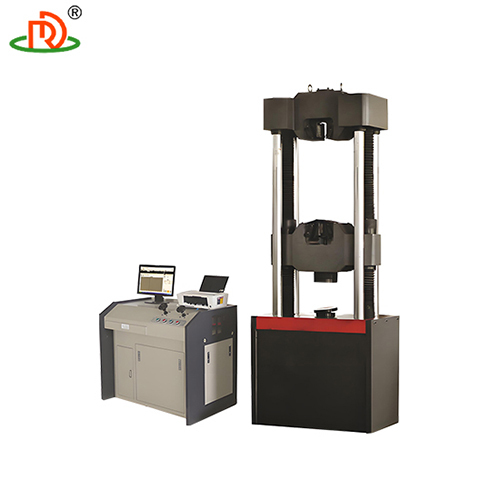
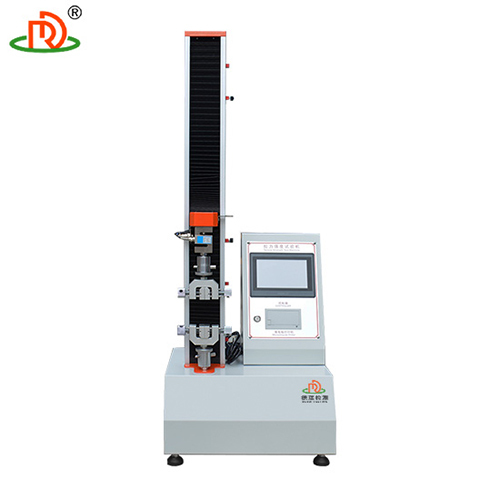
Compression Hydraulic Universal Tensile Testing Machine
6000.0 USD ($)/Unit
Product Details:
- Speed Range Adjustable
- Sensor No
- Screw Size Customized
- Application Industrial Labs
- Power 200 Volt (v)
- Click to view more
X
Compression Hydraulic Universal Tensile Testing Machine Price And Quantity
- 1 Unit
- 6000.0 USD ($)/Unit
Compression Hydraulic Universal Tensile Testing Machine Product Specifications
- Adjustable
- 200 Volt (v)
- No
- Customized
- Industrial Labs
Compression Hydraulic Universal Tensile Testing Machine Trade Information
- Cash in Advance (CID)
- 50 Unit Per Month
- 10 Days
- All India
Product Description
Specification
| Description | Parameters | ||
| Model | DR-L206 | ||
| Max. load | 300KN | 600KN | 1000KN |
| Load range | 6KN-300KN | 12KN-600KN | 20KN-1000KN |
| Load accuracy | 1% | ||
| Elongation resolution | 0.01mm | ||
| Piston stroke | 250mm | ||
| Max. piston stroke speed | 50mm/min | ||
| Elongation accuracy | 1% | ||
| Max. Tensile space | 300mm(excluding piston stroke) | ||
| Max. Compression space | 250mm(excluding piston stroke) | ||
| Display mode | PC | ||
| Clamping mode | Hydraulic | ||
| Operation mode | Manual | ||
| Flat sample thickness | 0-15 mm | ||
| Clamping width | 70mm | 70mm | 125mm |
| Round sample diameter | 10-32 mm | 13-40 mm | 13-60 mm |
| Compression plate size | 170*170mm | 170*170mm | 204*204mm |
| Load frame dimensions | 900*750*2200mm | ||
| Oil source dimensions | 1200 x 550 x 1100mm | ||
Versatile Testing Capabilities
This Universal Tensile Testing Machine offers both compression and tensile strength assessments, making it suitable for a wide range of materials including metals, polymers, and composites. Its adjustable speed control provides flexibility for different test scenarios and ensures compliance with varied industry standards.
Reliable Industrial Performance
Powered at 200 Volts, the machine delivers consistent performance for industrial lab environments. The customizable screw size lets users adapt to diverse sample dimensions, enhancing the accuracy and reliability of test results for quality control and research purposes.
FAQ's of Compression Hydraulic Universal Tensile Testing Machine:
Q: How is the Compression Hydraulic Universal Tensile Testing Machine used in industrial labs?
A: The machine is employed to evaluate the tensile and compressive strength of materials. It is commonly used in quality control and research labs within manufacturing and construction sectors, where users can adjust speed and customize the screw size for specific testing requirements.Q: What are the main benefits of choosing a customizable screw size?
A: A customizable screw size allows the machine to accommodate various sample dimensions, increasing its versatility and ensuring the accuracy of test results across different material types and sizes.Q: When should this machine be used for material testing?
A: This testing machine should be used whenever precise measurement of material strength is required, especially during research and development phases, routine quality assurance checks, and when verifying material performance for industrial projects.Q: Where is the machine typically exported and supplied from?
A: The Compression Hydraulic Universal Tensile Testing Machine is manufactured, exported, and supplied from China by a leading manufacturer specializing in industrial lab equipment.Q: What is the general process for operating the machine?
A: To operate, users adjust the speed to match the material test standard, set the appropriate screw size for the sample, and then initiate either a tensile or compression test. Data can be logged manually or with external measuring devices, as the machine does not have built-in sensors.Q: What are the advantages of not having built-in sensors?
A: By omitting built-in sensors, the machine streamlines maintenance, reduces the need for calibrations, and offers flexibility for users to connect their preferred external measurement tools as needed.Tell us about your requirement

Price:
Quantity
Select Unit
- 50
- 100
- 200
- 250
- 500
- 1000+
Additional detail
Mobile number
Email

Other Products in 'Universal Test Machine' category

Contact Details

- 1st Floor, No. 3, Shugang Avenue, Hongmei Town,Dongguan Guangdong, China
- Mr. Shirley (Manager)
- Mobile : +8615580327593
- Send Inquiry
-

Derui Testing Equipment Co., Ltd
 Send Inquiry
Derui Testing Equipment Co. Ltd
All Rights Reserved.(Terms of Use)
Developed and Managed by Infocom Network Private Limited.
Developed and Managed by Infocom Network Private Limited.
 English
 Spanish
 French
 German
 Italian
 Chinese (Simplified)
 Japanese
 Korean
 Arabic
 Portuguese