

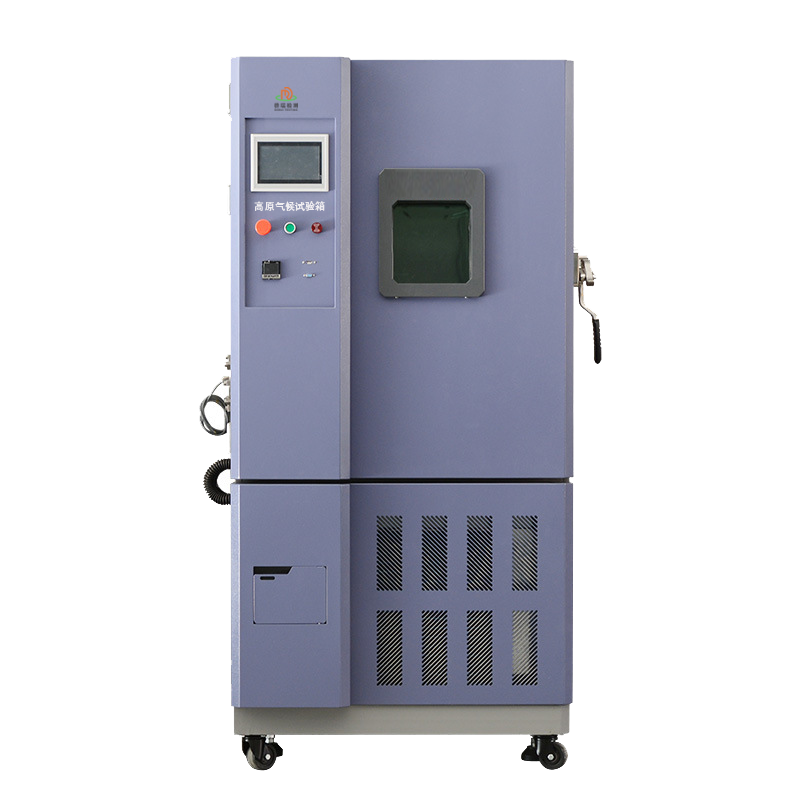
5000 feet altitude test chamber
688005.0 INR/Unit
Product Details:
- Response Time <30 seconds
- Gas Pressure Up to 2 Bar
- Features Programmable control, safety interlocks, overheat protection, alarm system
- Number of Specimens Up to 10
- Application Simulates high-altitude environmental conditions for testing electronics, automotive parts, aerospace, and military devices
- Display Type Digital Touchscreen Display
- Test Range 0~5000 feet (Altitude Simulation)
- Click to view more
X
5000 feet altitude test chamber Price And Quantity
- 1 Unit
- 688005.0 INR/Unit
- Advanced Air Cooled System
- PID Controlled Electric Heater
- Provided for mobility
- Overpressure relief, power failure alarm
- Built-in with USB export
- Powder Coated Mild Steel
- 65 dB(A)
- Hermetically Sealed
- High-density polyurethane foam
- Single door with observation window
- 2% RH
- Interior observation light
- Automatic via Integrated Vacuum Pump
- Rear maintenance panel
- Stainless Steel 304
- Silicone Gasket for Air-tight Sealing
5000 feet altitude test chamber Product Specifications
- Variable as per standard requirements
- 30% to 95% RH Adjustable
- 0 ft to 5000 ft
- -40C to +80C
- 350 L
- Customizable (Max 400400 mm)
- 220V/50Hz AC, Single Phase
- 220 V AC
- 600 mm
- 1% of set value
- 50 Hz
- 50 mm
- 5000 feet simulation
- 500 mm
- Chamber Inner Lining: Stainless Steel
- Digital Microprocessor-Based Controller
- Automatic
- Floor Stand
- 0~5000 feet (Altitude Simulation)
- Approx. 1200 kg
- Altitude Test Chamber
- RS232/USB
- 0.1 ft
- Reliability testing under different altitude conditions
- Up to 2 Bar
- <30 seconds
- Digital Touchscreen Display
- Simulates high-altitude environmental conditions for testing electronics, automotive parts, aerospace, and military devices
- Up to 10
- Programmable control, safety interlocks, overheat protection, alarm system
- Advanced Air Cooled System
- PID Controlled Electric Heater
- Provided for mobility
- Overpressure relief, power failure alarm
- Built-in with USB export
- Powder Coated Mild Steel
- 65 dB(A)
- Hermetically Sealed
- High-density polyurethane foam
- Single door with observation window
- 2% RH
- Interior observation light
- Automatic via Integrated Vacuum Pump
- Rear maintenance panel
- Stainless Steel 304
- Silicone Gasket for Air-tight Sealing
5000 feet altitude test chamber Trade Information
- Cash in Advance (CID)
- 100 Unit Per Month
- 7 Days
- All India
Product Description
Specifications:
| Internal dimension (W*D*H) | 1000*1000*1000mm |
| Temperature range | -70~+100(no load);-55~+100(with load) |
| Temperature fluctuation | 0.5 |
| Temperature uniformity | 2 |
| Ambient Humidity | 85%RH |
| Cooling speed | 1/min in average (with loading 15kg,+85~-55 ) |
| Heating speed | 1/min in average (with loading,-55~+85) |
| Pressure Range | 101Kpa~1Kpa |
| Pressure Accuracy | 5% |
| Pressure Control Method | Adjust temperature first, then pump vacuum |
| Internal chamber material | Steel plate with plastic spray |
| External chamber material | Stainless steel |
| Cooling method | Water Cooler |
| Controller | LCD touch screen, programmable control temperature and Pressure Can set different parameter for cyclic test |
| Insulation material | Compound material without sweating, special for low pressure |
| Heating Method | Electrical |
| Compressor | Imported new generation with low noise |
| Safety protection device | Protection for leakage Over-temperature Compressor over voltage and overload Heater short circuit |
1 Key parameters for simulating an altitude of 5000 feet
Altitude: 5000 feet (approximately 1524 meters)
Corresponding air pressure: approximately 84.3 kPa (standard sea level air pressure is 101.3 kPa)
Temperature range (optional):
Routine testing:- 40 C to+85 C
Extreme testing:- 70 C to+150 C (aerospace/military grade)
Humidity control (optional): 10%~98% RH (requires anti condensation design)
2 Application scenarios and industry standards
industry
test object
Typical testing objectives
Reference standards
Consumer Electronics
Mobile phones, drones, smartwatches
High altitude and low temperature start-up performance, heat dissipation capability
IEC 60068-2-13
automotive industry
Power battery ECU Sealing element
Electrical stability and airtightness verification under low pressure
ISO 16750-4, GB/T 28046.4
packaging materials
Food/drug packaging, modified atmosphere packaging
Packaging expansion and leakage risk testing
ASTM D6653, ISTA 3A
EADS
Onboard electronic equipment, oxygen mask
Reliability of Low Pressure Hypoxia Environment Function
RTCA DO-160, MIL-STD-810H
3 Equipment Selection Guide
1. Core parameter selection
Pressure range: To cover 84.3 kPa (5000 feet), it is recommended to choose equipment within the range of 1-100 kPa to accommodate more testing requirements.
Volume selection:
Small (50L~100L): Suitable for electronic components and sensor modules.
Medium size (200L~500L): suitable for automotive battery packs and instruments.
Control accuracy:
Pressure fluctuation: 0.5% FS (full range accuracy).
Temperature fluctuation: 1 C (economical type) or 0.5 C (high-precision type).
2. Function extension options
Temperature and humidity composite control: Simulate high-altitude, low-temperature, dry or humid environments (such as snow capped mountains or tropical plateaus).
Rapid depressurization mode: supports a depressurization rate of 5-10 kPa/min, testing the product's tolerance to sudden changes in air pressure.
Data recording: Configure USB/Bluetooth data export or cloud remote monitoring function.
Precision High-Altitude Simulation
Utilizing an integrated vacuum pump, this chamber effortlessly simulates altitudes from 0 to 5000 feet, with accurate, automatic adjustments and rapid response times under 30 seconds. The reliable control system delivers precision of 1% of the set value and humidity control of 2% RH, essential for rigorous reliability assessments.
User-Friendly Operation & Monitoring
Equipped with a digital touchscreen controller that supports programmable sequences, this chamber allows easy parameter setting and real-time monitoring. The inbuilt data logger with USB export enhances test traceability, and the observation window with interior lighting ensures clear visual inspection of processes.
Enhanced Safety and Maintenance
Overpressure relief, overheat protection, and a power-failure alarm offer comprehensive safety assurance during every operation. The rear service panel provides straightforward maintenance access while sturdy wheels or casters enable convenient relocation, underscoring the chamber's reliable design for laboratory and industrial environments.
FAQ's of 5000 feet altitude test chamber:
Q: How does the altitude test chamber simulate high-altitude environmental conditions?
A: The chamber uses an integrated vacuum pump to automatically reduce the internal air pressure, thereby replicating altitudes ranging from sea level up to 5000 feet. This process is managed by a digital microprocessor-based controller that ensures precise and rapid adjustment, with a response time of less than 30 seconds.Q: What materials are used for the construction of the chamber and why?
A: The internal chamber is fabricated from Stainless Steel 304 to provide excellent corrosion resistance and durability, while the external body is made from powder-coated mild steel for robust protection against environmental wear. High-density polyurethane foam insulation maintains steady internal conditions.Q: When should I use this altitude test chamber?
A: This equipment is ideal whenever electronic devices, automotive parts, aerospace components, or military devices must undergo reliability evaluations under varying altitude, humidity, and temperature conditions prior to deployment or certification.Q: Where can data from the testing processes be accessed or exported?
A: Test process data is logged by the inbuilt system and can be easily exported via the chamber's USB interface, providing clear documentation for further analysis and compliance reporting.Q: What is the process for adjusting altitude and environmental conditions within the chamber?
A: Users set their desired test profiles using the digital touchscreen controller. The altitude is then automatically regulated by the vacuum pump, while temperature and humidity are controlled via the programmable system and PID heater, ensuring accurate and repeatable test conditions.Q: How does the chamber ensure safety during operation?
A: Multiple safety features protect both the specimen and the user, including overpressure relief mechanisms, overheat protection, power failure alarms, and airtight silicone gasket sealing. These measures minimize operational risks and maintain secure test environments.Q: What are the main benefits of using this chamber for altitude testing?
A: Key benefits include its automatic altitude adjustment, versatile testing capabilities (temperature, humidity, pressure), precise digital control and data logging, enhanced safety, and robust construction. These allow diverse industries to conduct reliable, traceable, and efficient high-altitude simulations for product development and quality assurance.Tell us about your requirement

Price:
Quantity
Select Unit
- 50
- 100
- 200
- 250
- 500
- 1000+
Additional detail
Mobile number
Email

Other Products in 'Furniture Test Equipment' category


Contact Details

- 1st Floor, No. 3, Shugang Avenue, Hongmei Town,Dongguan Guangdong, China
- Mr. Shirley (Manager)
- Mobile : +8615580327593
- Send Inquiry
-

Derui Testing Equipment Co., Ltd
 Send Inquiry
Derui Testing Equipment Co. Ltd
All Rights Reserved.(Terms of Use)
Developed and Managed by Infocom Network Private Limited.
Developed and Managed by Infocom Network Private Limited.
 English
 Spanish
 French
 German
 Italian
 Chinese (Simplified)
 Japanese
 Korean
 Arabic
 Portuguese