

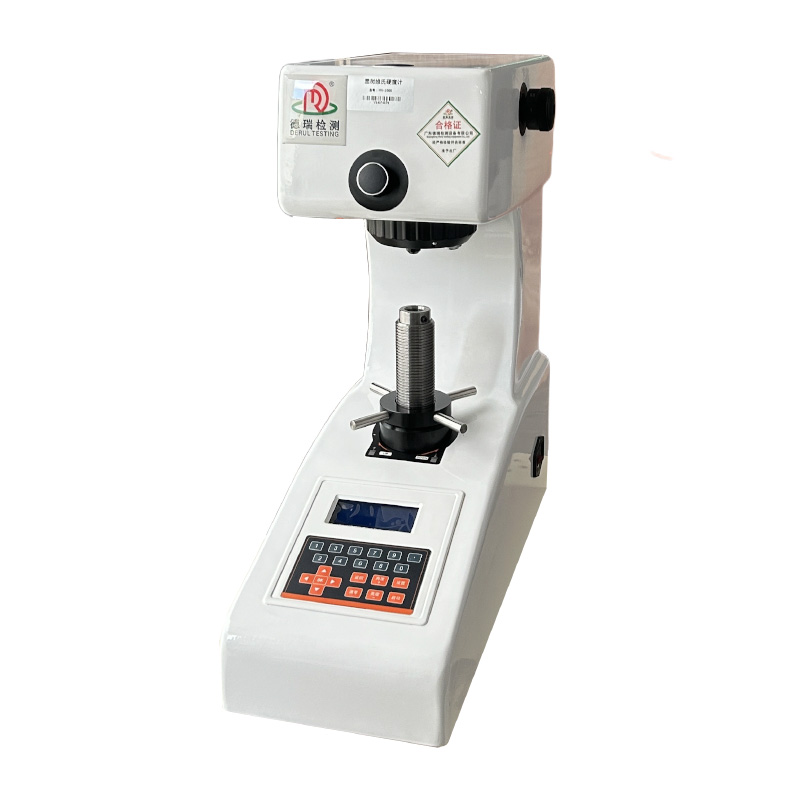
Universal Rockwell and Brinell hardness testers
155005.0 INR/Unit
Product Details:
- Display Type Analog Dial / Digital (optional)
- Automation Grade Semi-automatic
- Response Time Immediate (within 2 seconds)
- Measuring Range Rockwell: HRB, HRC; Brinell: 5-3000 kgf
- Features Combined Rockwell & Brinell operation, Sturdy body, Extended service life
- Application Metallurgical, engineering, foundries, research labs
- Max Height 200 mm (specimen height)
- Click to view more
X
Universal Rockwell and Brinell hardness testers Price And Quantity
- 155005.0 INR/Unit
- 1 Unit
- Supplied with calibration certificates
- Conforms to ISO 6506/6508, ASTM E10/E18
- Overload protection included
- Test blocks, weights, anvils included
- Optional PC control or stand-alone
- Diamond cone, steel ball (1/16", 2.5mm, 5mm, 10mm)
- 520 mm x 220 mm x 700 mm
- Powder coated corrosion-resistant
- Integrated test area illumination
- Fully automatic/manual load & unload
Universal Rockwell and Brinell hardness testers Product Specifications
- Immediate (within 2 seconds)
- Semi-automatic
- Analog Dial / Digital (optional)
- 200 mm (approx.)
- Rockwell: HRB, HRC; Brinell: 5-3000 kgf
- Combined Rockwell & Brinell operation, Sturdy body, Extended service life
- Metallurgical, engineering, foundries, research labs
- 200 mm (specimen height)
- 50 Hz
- 230 V AC, 50 Hz
- Hardness measurement of metals
- Rockwell & Brinell Scales
- Manual and Automatic (Motorized)
- Universal Rockwell & Brinell Hardness Tester
- Standard speed up to 3 mm/min (Adjustable)
- Rockwell: 20-100 HRB/HRC; Brinell: 100-600 HB
- Complies with IS:2281, IS:2282, IS:1586 standards
- Max. 150 mm
- Round up to 50 mm, Flat up to 100 x 150 mm
- 0.1 HR/0.5 HB
- 220-240V AC
- Standard sample port, 80 mm opening
- Up to 50 per batch
- 250 kgf (Max test force)
- 10C to 40C
- Manual/Optional Digital Output
- Approx. 85 kg
- Table Top
- Up to 90% RH, non-condensing
- Supplied with calibration certificates
- Conforms to ISO 6506/6508, ASTM E10/E18
- Overload protection included
- Test blocks, weights, anvils included
- Optional PC control or stand-alone
- Diamond cone, steel ball (1/16", 2.5mm, 5mm, 10mm)
- 520 mm x 220 mm x 700 mm
- Powder coated corrosion-resistant
- Integrated test area illumination
- Fully automatic/manual load & unload
Universal Rockwell and Brinell hardness testers Trade Information
- Cash in Advance (CID)
- 100 Unit Per Month
- 5 Days
- All India
Product Description
| Type | DR-C203 |
| Measuring range | 20-88HRA, 20-100HRB, 20-70HRC |
| Test force | 588, 980, 1471N (60, 100, 150kgf) |
| Max. height of test piece | 165mm |
| Distance from indenter to outer wall | 160mm |
| Rockwell scaleplate | HRA,HRB,HRC,HRD,HRE,HRF,HRG,HRH,HRK |
| Hardness measuring range | HRA:20-88 HRB:20-100 HRC:20-70 HRD:40-77 |
| HRF:60-100 HRG:30-94 HRH:80-100 HRK:40-100 | |
| Initial force | 1000kgf (98.07N) |
| Dimensions | 466 x 238 x630mm |
| Weight | Approx. 70kg |
| Accessories | Large flat anvil: 1 pc. Small flat anvil: 1 pc. V-notch anvil: 1 pc. Diamond cone indenter: 1 pc. 1/16" steel ball indenter: 1 pc. Rockwell standardized block: 5pcs. |
Comparison between Universal Rockwell Hardness Tester and Brinell Hardness Tester
Characteristics Rockwell hardness tester Brinell hardness tester
Testing method for measuring indentation depth and indentation diameter
Cone shaped diamond indenter or hard alloy ball
Small load range, suitable for larger loads on harder materials, suitable for softer materials
Testing time is fast and slow
Small indentation size, large indentation size
Application areas: Various hardness metal materials, various metal materials
Advantages: fast, high-precision, multi-scale large indentation, high precision, wide applicability
difference
Measurement principle:
Rockwell hardness tester: Determine hardness by measuring indentation depth.
Brinell hardness tester: Determine hardness by measuring the indentation diameter.
Applicable materials:
Rockwell hardness tester: suitable for metal materials with high hardness, such as quenched and tempered steel, quenched and tempered steel, etc.
Brinell hardness tester: suitable for materials with low or moderate hardness, especially castings, forgings, and non-ferrous metals.
Operational complexity:
Rockwell hardness tester: easy to operate, fast to measure, suitable for rapid testing on production sites.
Brinell hardness tester: The operation is relatively complex, but due to its high accuracy, it is suitable for situations that require precise testing.
Versatile Testing for Diverse Applications
Designed for metallurgical, engineering, foundry, and research laboratory use, this Universal Rockwell and Brinell Hardness Tester supports a wide range of metal specimens, accommodating round samples up to 50 mm and flat samples up to 100 x 150 mm. The tester's broad measuring range and inclusion of essential accessories make it suitable for routine quality control and advanced material research.
Robust Design and User-Friendly Operation
Featuring a sturdy, powder-coated frame that resists corrosion, this machine offers an extended service life in busy industrial environments. The system supports both manual and fully motorized operation, allowing users flexibility according to workspace preferences. Integrated illumination, immediate response times, reliable protection features, and intuitive controls facilitate efficient and safe operation.
FAQ's of Universal Rockwell and Brinell hardness testers:
Q: How are different indenter types used in this hardness tester?
A: This tester supports diamond cone and multiple steel ball indenters (1/16", 2.5mm, 5mm, 10mm), enabling precise Rockwell and Brinell measurements on various materials. Indenter selection is based on the chosen hardness scale and the material being evaluated.Q: What benefits does fully automatic load and unload provide over manual operation?
A: Fully automatic cycles ensure consistent force application, minimize user variation, and increase throughput, especially when testing up to 50 specimens per batch. However, manual cycles are available for specialized or single-sample testing scenarios.Q: When and how should the tester be calibrated?
A: Calibration should be performed prior to first use and at regular intervals using the included test blocks and weights. Each unit is supplied with calibration certificates traceable to relevant standards, ensuring ongoing accuracy and compliance.Q: Where can this universal tester be effectively installed?
A: With a table top mounting design and powder-coated, corrosion-resistant finish, the tester is suitable for installation in workshops, laboratories, and industrial settings with operating conditions between 10C-40C and up to 90% RH.Q: What process does the tester follow to measure hardness?
A: The specimen is secured, the appropriate indenter and test force are selected, then the load is applied (automatically or manually) and the resulting indentation is measured. Results are immediately displayed on the analog dial or digital interface.Q: How does the tester ensure accuracy and safety during operation?
A: Accuracy is maintained through compliance with IS:2281, IS:2282, and IS:1586, as well as international standards. Overload protection is built in, and integrated lighting enhances visibility in the test area for precise handling.Q: What are the usage benefits of combining Rockwell and Brinell operations in one machine?
A: Having combined Rockwell and Brinell capabilities broadens the range of materials and hardness scales this tester can address, saving space, reducing equipment costs, and streamlining workflows for users needing both types of hardness measurements.Tell us about your requirement

Price:
Quantity
Select Unit
- 50
- 100
- 200
- 250
- 500
- 1000+
Additional detail
Mobile number
Email

Other Products in 'Leather And Shoes Testing Machine' category

Contact Details

- 1st Floor, No. 3, Shugang Avenue, Hongmei Town,Dongguan Guangdong, China
- Mr. Shirley (Manager)
- Mobile : +8615580327593
- Send Inquiry
-

Derui Testing Equipment Co., Ltd
 Send Inquiry
Derui Testing Equipment Co. Ltd
All Rights Reserved.(Terms of Use)
Developed and Managed by Infocom Network Private Limited.
Developed and Managed by Infocom Network Private Limited.
 English
 Spanish
 French
 German
 Italian
 Chinese (Simplified)
 Japanese
 Korean
 Arabic
 Portuguese